
High-quality water treatment is needed not only by residents of large cities: impurities in water are increasingly encountered in small, remote settlements as well. Modern treatment systems have become much more effective, but there is no universal filter — the system is selected for the composition of the specific water.
Filter classification
- automatic units with filter media;
- cartridge filters with replaceable cartridges;
- self-cleaning screen and disc filters;
- manually flushed filters.
Good to know There is no device that removes all harmful impurities from water at once. Every system has its pros and cons, so treatment is built from several stages, each of which solves its own task.
Mechanical treatment
Mechanical, or sediment, filters retain suspended particles of clay, sand, rust and other insoluble impurities. As part of a system, mechanical treatment helps remove iron and manganese ions and organic impurities, reduce hardness and improve the organoleptic properties of water.
| Type | What it retains | Features |
|---|---|---|
| Cartridge | relatively large particles — from a few microns | the simplest and cheapest; cartridges need replacing |
| Screen | particles larger than the ~0.05 mm mesh | fairly fine filtration; the screen needs regular flushing |
| Media bed | a wide range of suspended solids | the most powerful sediment filter; the media is aluminosilicates or special ceramics |
Other treatment stages
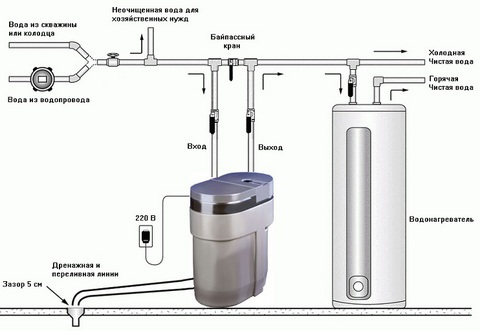
- Softeners. Excess hardness is tackled by automatic softener filters — they protect water heaters, boilers, washing machines and dishwashers from scale.
- Carbon filters. They have long and successfully improved the taste and smell of water, removing chlorine and organic matter.
- Drinking water polishing. A separate group consists of units for fine treatment of a small volume of water for drinking and cooking. The simplest option is a sediment filter plus a carbon filter.
- Reverse osmosis. Provides the highest degree of polishing; the number of filter units in such systems reaches six.
Signs that your water needs treatment
- reddish deposits on plumbing fixtures and rust stains on laundry — excess iron;
- scale in the kettle and on heating elements, white streaks on dishes — high hardness;
- a smell of chlorine or hydrogen sulphide, a metallic taste;
- turbidity and sediment in settled water — suspended solids, sand, clay;
- tap aerators and shower heads clog quickly.
System maintenance
| Element | What to do | How often (approximately) |
|---|---|---|
| Mechanical and carbon cartridges | replacement | every 3–6 months, depending on contamination |
| Screen filter | flushing | as the pressure drops |
| Softener | topping up regeneration salt | according to consumption, usually monthly |
| Reverse osmosis membrane | replacement | every 1.5–3 years |
The intervals depend on the quality of the source water and the volume of consumption; we will draw up an exact schedule after selecting the system. An overdue cartridge does not just stop cleaning the water — it can itself become a source of contamination.
Water treatment for a boiler
Hard water and iron quickly damage the heat exchangers of boilers and water heaters: scale reduces heat transfer and increases fuel consumption. For heating and hot water systems, including those with heat pumps and solar collectors, water treatment should be provided from the start — it is cheaper than repairing the equipment.
Which system you need
City water supply
- a mechanical filter at the inlet;
- a carbon filter against chlorine and odour;
- a softener for hard water;
- drinking water polishing or reverse osmosis in the kitchen.
Borehole, country house
- a water analysis is essential before selection;
- mechanical removal of sand and suspended solids;
- iron and manganese removal;
- softening and final polishing.
Tip Start with a laboratory water analysis. Without it, it is easy to buy an expensive system that does not cope with the main problem — for example, iron in borehole water.
How we work
- Consultation We assess the task free of charge and, if a system is already installed, check whether the water treatment has been installed correctly.
- Analysis and selection Based on the analysis results, we propose the set of stages and equipment from the full range of modern filters.
- Installation We install the system in an apartment, a country house, a summer house or at a borehole, connect it and set up the automation.
- Maintenance We will advise on a schedule for replacing cartridges and media and provide service.
High-quality treatment protects against heavy metals and microbes: tap water can be drunk without worry — both in a city apartment and out of town. Other solutions for the home are in the "Energy Efficiency" section.
We will select a filter for your water Tell us about the source — mains water or a borehole — and what you are not happy with about the water. The consultation is free.
Get a consultation