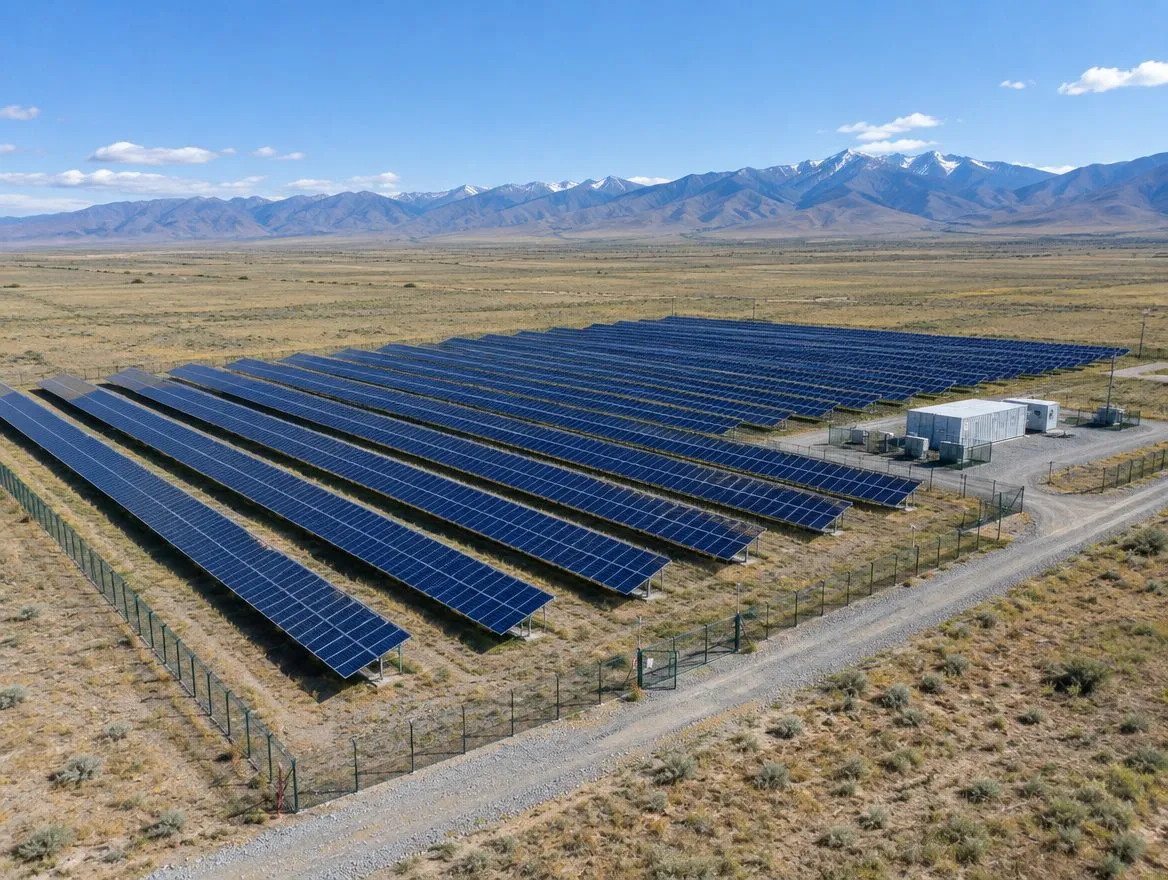
Fossil fuel reserves are shrinking and the products of their combustion pollute the environment, so more and more homes and businesses are getting energy from the Sun — an inexhaustible source. The task of a solar panel is to convert sunlight into electricity as efficiently as possible.
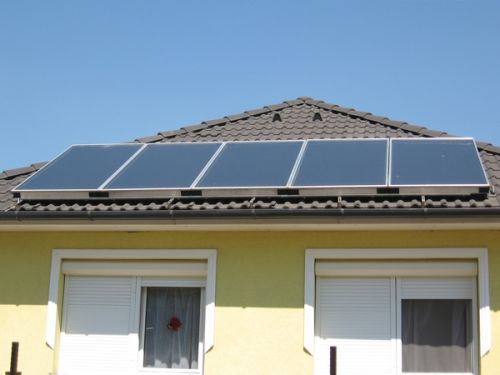
What a solar power plant consists of
A solar power plant is a photovoltaic system that generates and stores energy. It includes:
- solar panels (modules);
- batteries;
- a battery charge-discharge controller;
- an inverter.
How it works: light falls on the panel cells, a direct current is generated, and the inverter converts it into alternating current. The alternating current goes straight to consumers and, if there are batteries, is partly stored. Panels generate electricity even without direct sunlight, in diffused light, although less of it.
Types of silicon panels
Photovoltaic modules are made of silicon — the second most abundant element in the Earth's crust after oxygen.
| Type | Efficiency (source review data) | Price | Features |
|---|---|---|---|
| Monocrystalline | 15% on average | the most expensive | the most efficient conversion |
| Polycrystalline | 11% on average | cheaper | simpler silicon production technology |
| Amorphous | low | the least expensive | shorter service life; flexible models |
Good to know The efficiency values given are historical averages. Modern mass-produced modules, on average across the market, have noticeably higher efficiency, and the technology continues to develop. Panel prices also change constantly, so selection is made for a specific project.
The power of a single module is limited (in the source review — from 6 to 150 W), so several modules are combined into an array to achieve the required power.
Tilt angle and bifacial modules
The angle of incidence of sunlight changes during the year, and output depends on it. If a tracking structure is not provided, the optimal fixed tilt angle for the latitude of the site is chosen during installation.
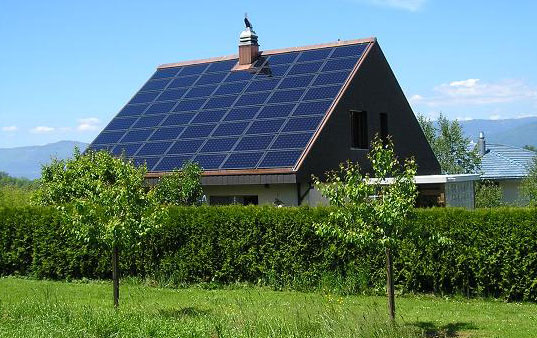
Some manufacturers produce bifacial modules that receive light on both the front and the back. From the same area they deliver 15–20% more energy — especially on light-coloured surfaces and ground-mounted racks.
Tip Before installing on a roof, check the load-bearing capacity of the rafter system and the snow load. Technical supervision or a survey will help with this.
Flexible and portable batteries
Small flexible amorphous silicon batteries provide enough energy to charge phones, laptops and other mobile devices. They are less powerful than crystalline modules, but they are compact and can be folded and rolled up — indispensable on a hike. There are flexible batteries that keep working even after serious mechanical damage.
Manufacturers and developments
Over the years, the world leaders in photovoltaic cell production have included Q-Cells (Germany), First Solar (USA), Suntech Power (China) and Sharp (Japan). In the CIS countries, photovoltaic panels were developed by, among others, VIESKh and JSC VIEN, NPP "Kvant", NPF "Kvark", Kovrov Mechanical Plant, NPO Mashinostroyeniya, FSUE "NIIPP", the design bureau of the "Krasnoye Znamya" plant, the "Pozit" pilot plant, Ryazan Plant of Metal-Ceramic Devices, Solnechny Veter LLC, SOVLAKS LLC, JSC "Saturn", NPF "Sanenergy", CJSC "Telecom-STV", JSC "Elma" and the Ioffe Physical-Technical Institute centre.
New technologies
- Photosensitive "paint". Nanoparticles are sprayed onto the battery substrate — this is considerably cheaper. Efficiency is currently about 1%, but the developers expect to bring it up to 10% (technology by Brian Korgel, University of Texas at Austin). In the future, such paint could be applied directly to roofs.
- Concentrator modules. The Ioffe Institute (St Petersburg) created a module based on nano-heterostructures with an efficiency of 37–45%: a Fresnel lens concentrates radiation onto a small high-efficiency cell. More than 5 billion roubles were planned to be raised for the project, including from foreign investors.
- Thin-film cells. Sharp created a film 1–3 µm thick: a battery the size of two business cards with an output of 2.6 W powers a bicycle lamp.
Developers name the silicon surface of most panels as the main limitation on efficiency and link efficiency gains to nanotechnology. Oil companies have also joined in: Shell opened a division producing solar panels, and BP signed an agreement with the California Institute of Technology on the use of nanotechnology in photovoltaic cells. Mass adoption of the newest developments is still held back by their high cost.
What we do
- Calculation We assess consumption, the area and orientation of the roof or plot, and select the plant capacity and battery capacity.
- Equipment selection Panels, inverter, controller, mounting — to suit the budget and the task.
- Installation and connection Installation, configuration, trial start-up and briefing.
A solar power plant works well in combination with solar collectors for hot water and a heat pump for heating. All solutions are in the "Energy Efficiency" section.
Let us calculate a solar power plant for your facility Tell us your average electricity consumption and address — we will select a kit and estimate the payback.
Submit a request