
A solar collector heats water and heat-transfer fluid using the energy of the Sun. It is installed on a roof, a wall or an open area next to the house and used for hot water supply, heating and swimming pool heating — in a private home, a country house, a hotel or a business.
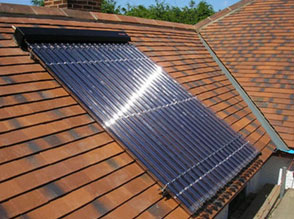
A collector and a solar panel are not the same thing
A solar panel converts light into electricity, while a collector converts it into heat. For hot water and heating, a collector is usually more efficient: it heats the heat-transfer fluid directly, without intermediate energy conversion.
Types of solar collectors
| Type | How it works | Where it fits |
|---|---|---|
| Flat-plate with selective coating | a panel with an absorber plate and a special coating that retains heat | warm season, hot water, pool heating |
| Direct-flow evacuated tube | the heat-transfer fluid passes directly through the vacuum tubes | year-round hot water supply |
| Evacuated tube with heat pipes | heat is transferred through sealed heat pipes to the manifold heat exchanger | heating and hot water in cold weather, support for the heating system |
Good to know Vacuum insulation reduces heat loss, so evacuated tube collectors usually perform better in frost and diffused light, while flat-plate collectors are simpler and cheaper for summer use.
How to choose a collector
The type and model depend on several factors:
- purpose: space heating, preheating or constant heating of water;
- regularity: constant hot water supply, heating in the winter season, warm water at a country house, pool heating;
- required temperature: low for preheating, high for domestic hot water;
- installation location: roof, wall, ground area; orientation and shading;
- existing system: whether there is a boiler, a water heater or a heat pump to which the collector can be connected.
Tip A collector most often works together with a main heat source: it takes on a significant share of the load on sunny days, while a boiler or heat pump tops up the water temperature in cloudy weather. This keeps the system reliable all year round.
Solar collector for a swimming pool
The water heating system should be thought through at the design stage of any type of pool. A comfortable water temperature, like air temperature, depends on how actively people are moving. At the same water and air temperature, a person in water cools down about 20 times faster than in air, so even slight underheating is felt immediately.
For seasonal heating of an outdoor pool, simple flat-plate collectors are usually enough: the pool is needed precisely when there is plenty of sun. For indoor pools that operate all year round, evacuated tube collectors combined with another heat source are more often used. Covering the pool with a film at night significantly reduces heat loss and allows a smaller collector area.
What the system consists of
- collectors and a mounting frame set to the tilt angle;
- a storage tank (water heater) with a heat exchanger;
- a pump group and an expansion tank;
- a controller that turns on circulation when the collector is warmer than the tank;
- insulated pipework and heat-transfer fluid.
The tank size is chosen according to the daily hot water consumption of the family or facility: a tank that is too small quickly overheats, while one that is too large does not have time to warm up.
How much it costs
When choosing a collector, price is usually more important to the client than considerations of efficiency. But only a specialist can correctly calculate the system — the collector area, the storage tank volume, the connection scheme — otherwise it is easy to overpay for excess capacity or get too little heat. Contact us: we will estimate the costs, propose the optimal solution and, if necessary, calculate solar panels for the same roof.
How we work
- Visit and calculation We assess the need for hot water and heat, the installation location, orientation and shading.
- System selection Type and number of collectors, storage tank, pump group, automation.
- Installation Mounting on the roof or ground area, connection to the existing heating and hot water system.
- Start-up and adjustment Filling the circuit, setting up the controller, operating instructions.
Attention In winter the collector circuit must be filled with antifreeze heat-transfer fluid, and in summer it must be protected from overheating when no water is being drawn. Errors in the scheme are a common cause of failure in home-made systems.
Collectors complement other solutions in the "Energy Efficiency" section well. They can be included straight away in private house construction.
We will select a solar collector for your needs Tell us what you need heat for — hot water, heating or a pool — and we will propose a solution with a calculation.
Submit a request